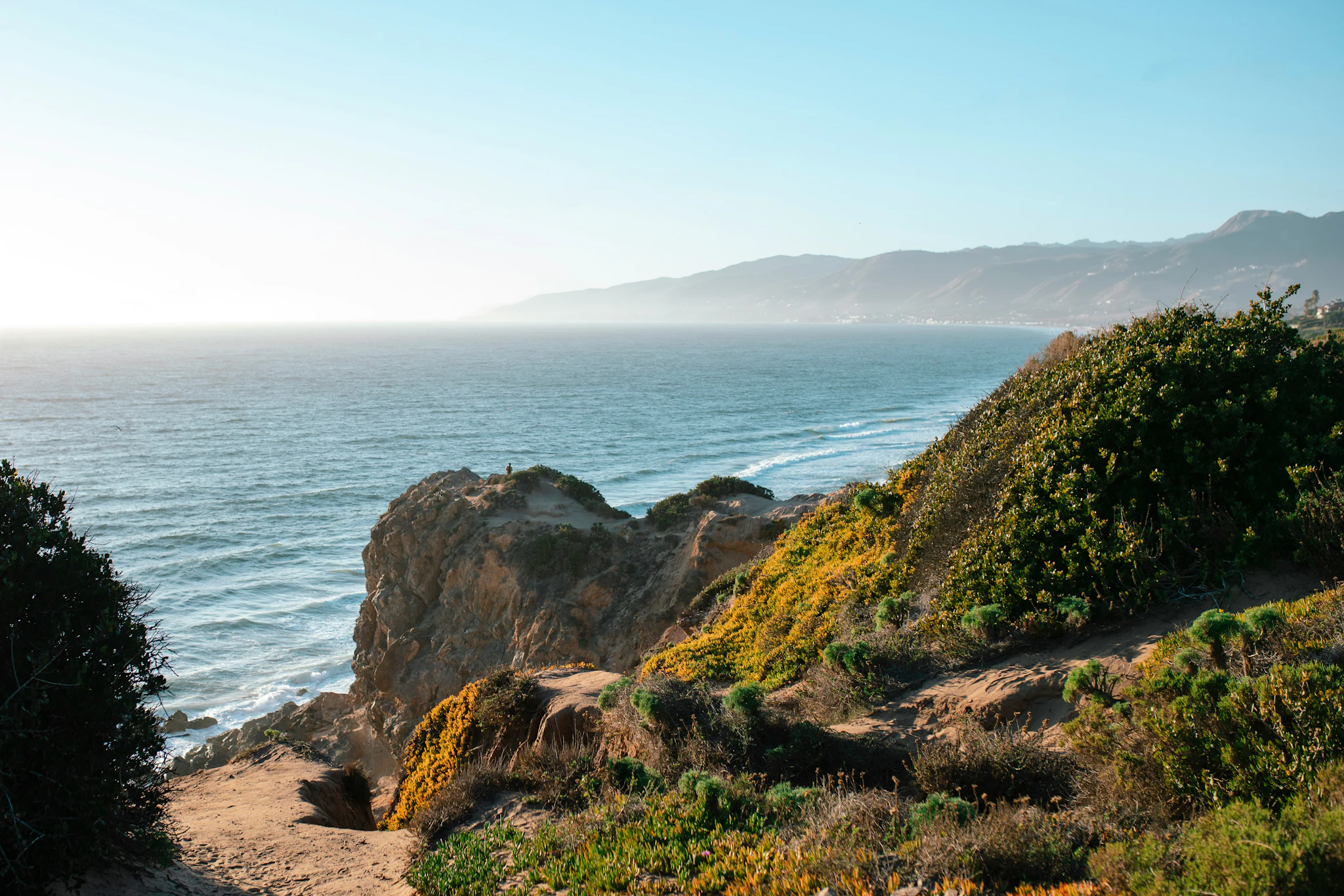
To truly experience Malibu is to step outside the walls of your estate and engage directly with the terrain. The landscape here demands active participation, defined by a dramatic meeting of the rugged Santa Monica Mountains and the vast expanse of the Pacific Ocean.
This guide completely bypasses generic, uninspired walks in favor of serious, specific outdoor pursuits. These are the exact trailheads, beach access coordinates, and court placements that matter, complete with the critical timing, marine layer insights, and seasonal nuances that separate a standard outing from a perfect day on the coast.
Early Morning: Mountain Crests & Hidden Canyons
In Malibu, the early morning belongs entirely to the mountains. The immediate goal is to scale the interior trails early enough to watch the morning fog line break over the ocean, escaping the midday heat before the sun reflects off the exposed rock faces.
Solstice Canyon Trail
A highly dynamic canyon hike that transitions from shaded groves of mature coast live oaks and sycamores to the historic architectural ruins of the Roberts Ranch house, which burned down in a historic wildfire in 1982. The path winds along a trickling freshwater creek before climbing steeply into the bright coastal sunshine.
- The Route: Enter via the main Solstice Canyon Trailhead located at the end of Corral Canyon Road. For a serious physical challenge, skip the flat TRW trail and commit directly to the Rising Sun Trail loop. This path climbs steeply along the exposed eastern ridgeline, positioning you high above the canyon floor with sweeping views of the coastline.
- The Timing: Arrive by 7:30 AM. This improves your chances of securing a parking space at the trailhead and ensures you complete the intense, sun-exposed ridgeline climb before the canyon walls trap the heavy midday heat.
Los Leones Trail to Parker Mesa Overlook
Positioned on the eastern boundary where the mountains meet Pacific Palisades, the Los Leones corridor is the definitive morning checkpoint for residents seeking a rigorous, vertical-ridge workout. The trail is characterized by a dramatic single-track switchback path that cuts through lush coastal chaparral before climbing steeply onto an exposed, high-altitude fire road that overlooks the entire crescent of the Santa Monica Bay.
- The Route: Begin at the Los Leones Trailhead, located just off Sunset Boulevard and Los Leones Drive, where parking and dedicated facilities are available. Take the initial single-track trail up through the canyon for about 1.5 miles, and then join the East Topanga Fire Road to complete the final push up to the 1,525-foot summit of Parker Mesa Overlook.
- The Timing: Start your ascent by 7:00 AM. On summer mornings, this timing ensures you can push past the lower canyon shadows and hike completely above the dense marine layer, reaching the bench at the overlook just as the sun breaks cleanly over the white blanket of fog rolling across the ocean below.
- Periodic Closures: Trail conditions and access may change following recent wildfire recovery efforts, so check current status before departure.
Mishe Mokwa Trail to Sandstone Peak
Sandstone Peak offers one of the most demanding and rewarding hikes in the Santa Monica Mountains. The terrain is rugged and volcanic, surrounded by massive crags, hidden grottos, and chaparral-covered valleys that feel completely removed from the city below. On a perfectly clear morning, the summit delivers unobstructed views of the Channel Islands floating on the horizon.
- The Route: The trailhead is located along Yerba Buena Road, a scenic, winding mountain drive up from the far western edge of the Pacific Coast Highway. Take the full six-mile Mishe Mokwa loop, which snakes past massive volcanic rock formations like Echo Cliffs before reaching the 3,111-foot summit of Sandstone Peak.
- The Timing: This is a rigorous, three-hour commitment. Hit the trail by 6:45 AM to catch the cool mountain air and watch the low-lying morning mist clear out of the deep mountain valleys.
Midday & Full-Day: The Serious Surf & Coastal Sand
When the sun is high and the morning marine layer has fully dissolved, the focus shifts squarely to the water, the surf breaks, and the wide expanses of coastal sand.
Point Dume State Beach & Preserve
A magnificent, ancient volcanic bluff that acts as the geographic anchor of central Malibu, complete with pristine tide pools, sheer rock climbing faces, and a protected marine conservation area. The preserve overlooks the entire Santa Monica Bay, serving as a vital ecological viewing point for winter migrating gray whales and local sea lion colonies.
- The Route: Avoid the busy public lots and utilize the limited spaces on Cliffside Drive if available, or access the sand from the Westward Beach side. Climb the restored boardwalk trail to the absolute summit of the point, and then take the steep wooden staircase down into Pirate’s Cove, a highly insulated beach largely sheltered from the afternoon wind by the surrounding cliffs.
- The Timing: A perfect full-day destination. Check the local tide charts carefully before descending; the exceptional tide pools on the eastern shelf of the point are fully revealed only during true low tide windows, exposing a vibrant world of sea anemones and sea stars.
Surfrider Beach and First Point
The absolute epicenter of classic Southern California surf culture, Surfrider Beach is a world-renowned reserve famous for its flawless, right-hand point breaks. The beach sits adjacent to the historic wooden pier, where the shape of the cobblestone delta creates long, peeling waves that ride for hundreds of yards.
- The Route: Pull into the dedicated lot just north of the Malibu Pier. Walk down past the historic Adamson House to enter the sand at the mouth of the Malibu Lagoon.
- The Etiquette: First Point is the legendary home of Malibu longboarding, characterized by smooth, consistent style. The lineup here is tight and deeply respected; visiting surfers should observe the local rotation before paddling into the peak to show respect for the seasoned locals who have ridden these waves for decades.
Zuma Beach (Access Gate 8 or 9)
The ultimate destination for serious open-water swimming, paddleboarding, and unobstructed beach training. Unlike the narrow, rocky strips of the eastern coast, Zuma is a sweeping, wide expanse of pristine white sand that stretches for nearly two miles along the open ocean.
- The Route: Avoid the chaotic central parking zones and the crowded concessions. Pull directly into the northern gates near Access Point 8 or Access Point 9, where the sand is widest and the shoreline is significantly less crowded.
- The Timing: Perfect for a full afternoon under the sun. The water here drops off quickly, creating crisp, clean swells that are ideal for body surfing and long-distance ocean swimming, away from the rocks and kelp beds of the southern coves.
Shoulder of the Day: Golden Hour Architecture & Cliffside Trails
The late afternoon and early evening require locations that maximize the dramatic angles of the setting sun, where the light hits the coastal bluffs at a sharp, golden angle.
El Matador State Beach
The most visually dramatic pocket of sand in Southern California, famous for its massive sea stacks, arched rock formations, and hidden caves carved out by the Pacific. The beach feels entirely prehistoric, dominated by towering pillars of stone that rise directly out of the surf line.
- The Route: Located along western Malibu, the trailhead is a steep, winding bluffside path that transitions into a rustic wooden staircase descending down the face of the cliff.
- The Seasonal Nuance: This is strictly a shoulder-of-the-day destination, optimized for the final ninety minutes before twilight. The massive sea caves and rock arches are dangerous and completely inaccessible at high tide. You must time your arrival to coincide with a receding tide to safely explore the interior rock structures and watch the golden rays of the sun pierce through the stone arches.
Scenic Drives: The Art of the Canyon Road
To fully comprehend the scale of Malibu, one must experience the mountain passes that connect the ocean to the interior valleys. These roads are masterclasses in civil engineering, twisting through deep gorges and along high ridges.
Latigo Canyon Road
While Malibu Canyon and Kanan Dume are the primary commercial arteries, Latigo Canyon is the connoisseur’s driving road. It is a tight, rhythmic ribbon of asphalt that climbs from the beaches of central Malibu up to the crest of the mountains, featuring dozens of hairpin turns and panoramic views that shift with every corner.
- The Route: Turn inland off the Pacific Coast Highway just past Escondido Beach. Follow Latigo Canyon Road as it climbs past luxury mountain estates, vineyards, and sandstone cliffs.
- The Drive: This road requires total focus and an appreciation for automotive balance. It is best driven in the late afternoon, when commuter traffic is non-existent, and the low sun casts long shadows through the mountain canyons, illuminating the ocean behind you.
Courts & Courses: Elite Turf & Private Play
Finding a place to play golf or tennis along this rugged terrain requires navigating highly exclusive private registries and knowing where public access is actually worth the drive.
The Tennis Secret: Malibu Racquet Club
Perched high on a plateau overlooking the civic center and the ocean, this legendary private facility features beautifully maintained, high-visibility hard courts nestled against a dramatic mountain backdrop. It has long served as the athletic hub for Malibu’s elite resident community.
- The Access Protocol: While it operates primarily as an elite private club for local estate owners, guest access and private instruction opportunities may be available through club arrangements and concierge coordination. It represents the gold standard for serious court play along the coast.
The Golf Reality: Escaping the Coast
There are currently no active public golf courses remaining within the geographical boundaries of Malibu proper. The historic Malibu Country Club, tucked deep in the canyons, has long been closed, meaning players looking to tee off must look just over the mountain ridge or farther down the coast.
- Sherwood Country Club (Thousand Oaks): For serious golfers requiring a premier experience, this private Jack Nicklaus-designed masterpiece is the definitive choice. It is strictly private, meaning access is generally limited to members and approved reciprocal arrangements. The scenic drive up through Kanan Dume Road makes it an easy morning commute.
- Los Robles Greens (Thousand Oaks): If you prefer a highly accessible, unpretentious public option that still delivers exceptional play, this course sits just on the other side of the canyon corridor. It offers a fantastic, newly redesigned layout that winds through historic oak trees, providing a great afternoon option away from the ocean breezes.
The Maimon Experience: Effortless Adventure
Engaging with the outdoor terrain of Malibu should be entirely seamless, free from the logistical friction of equipment transport, trail navigation, or gate closures. The Maimon Group ensures that your active itinerary is executed with absolute precision.
Whether it is arranging for private, certified surf instructors to meet you on the sand at Surfrider with custom boards, coordinating private guided trail runs through the backcountry of Mishe Mokwa, or utilizing our personal networks to secure court times at the exclusive Malibu Racquet Club, every detail is managed directly by your concierge.
For days spent on the water, we can coordinate private yacht charters departing from Marina del Rey, fully equipped with paddleboards, diving gear, and a dedicated crew. From a fully catered gourmet beach setup waiting for you at Zuma after a long ocean swim to a private massage therapist arriving at your estate the moment you return from scaling Sandstone Peak, your active lifestyle is supported with total comfort and luxury.